For U.S. banks, credit unions and their service providers

Incident notice and third-party oversight, built for the rules you are examined on.

CRINDATA connects financial institutions with their critical vendors in one secure record: incident notices in minutes, a live view of vendor and fourth-party dependencies, and evidence your examiners can rely on.

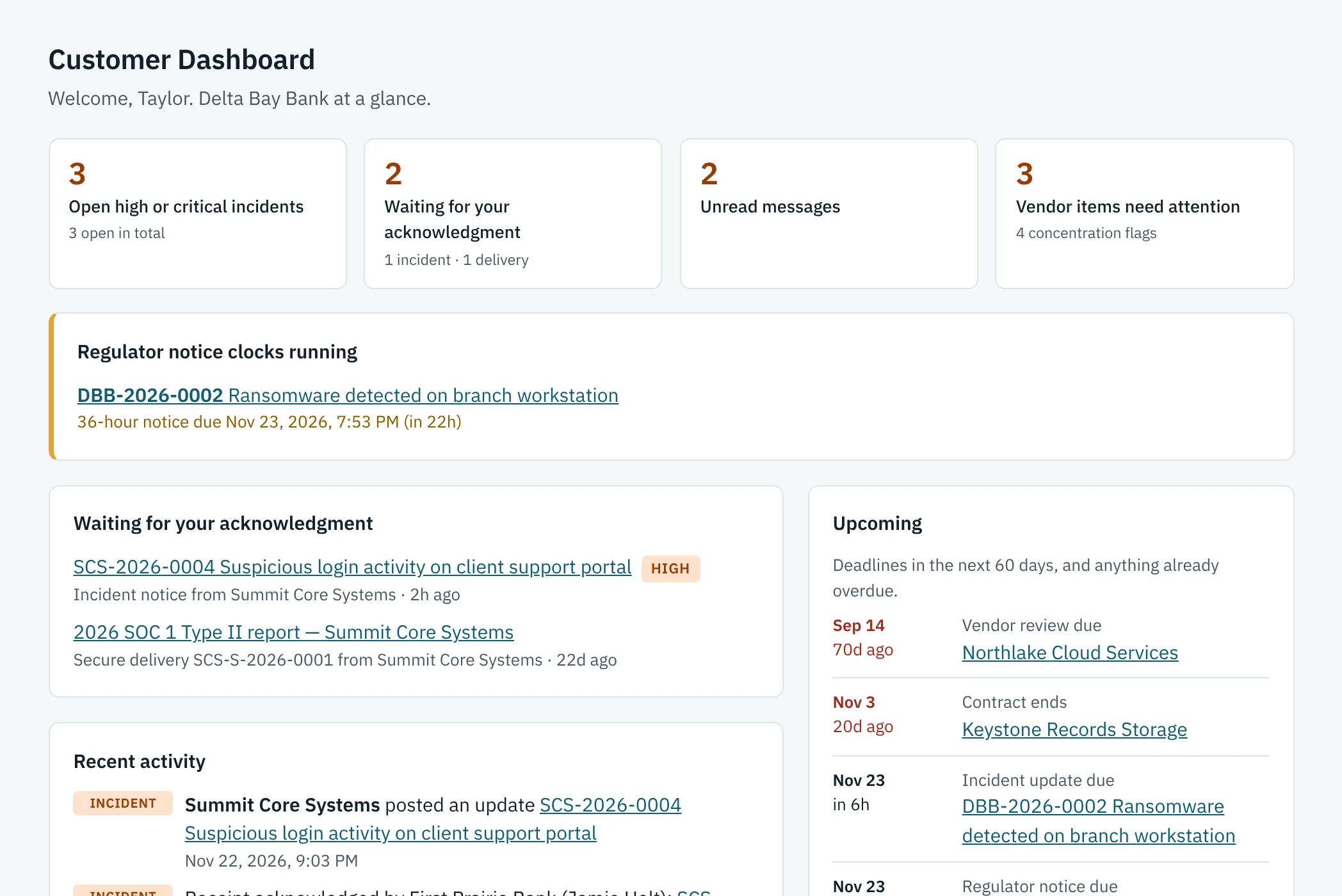
CRINDATA dashboard showing open incidents, items awaiting acknowledgment, a regulator notice clock and upcoming deadlines
A bank’s dashboard: what needs attention now, and what is due next.
36hours

for a bank to notify its primary federal regulator after determining that a notification incident has occurred.

Computer-Security Incident Notification Rule (OCC, Federal Reserve, FDIC)
4hours

of actual or likely material disruption triggers a bank service provider’s duty to notify its bank customers as soon as possible.

Same rule, bank service provider requirement
72hours

for a federally insured credit union to report a reportable cyber incident to the NCUA.

NCUA cyber incident notification rule (12 CFR 748.1)

The clock starts with your vendor. CRINDATA makes sure the notice reaches you in minutes, records when you received and acknowledged it, and tracks the deadline that applies to you.

The risk in your vendor chain

Nearly half of all breaches now involve a third party

When a vendor is breached, every institution it serves has a problem, and the vendor’s own subcontractors are often where it starts. Knowing about and tracking incidents across your whole vendor chain is now central to managing third-party risk.

48%

of breaches in Verizon’s 2026 Data Breach Investigations Report involved a third party, up from 30% a year earlier.

247days

on average to identify and contain a breach in 2026. Supply-chain compromise adds more to the cost of a breach than any other single factor.

74banks and credit unions

named in state breach notices after a single marketing vendor was hit by ransomware in 2025. More than 670,000 people were affected.

Sources: Verizon 2026 DBIR; IBM Cost of a Data Breach Report 2026; BleepingComputer and Credit Union Times on the Marquis breach.

Vendor incident watch

Recent incidents at companies that serve banks and credit unions

See all incidents →
November 19, 2026 · Data theft · Unnamed marketing data vendors

J.P. Morgan, Visa and Mastercard report cyberattack on vendors holding customer marketing data

J.P. Morgan said third parties that provide services to the firm were the target of a cyberattack, and that attackers accessed certain marketing data held by those vendors, which may include customer names and email addresses. Visa and Mastercard also reported possible exposure of customer information. The vendors were not named.

Statement: J.P. Morgan said its primary banking and payment systems were not affected and that it would contact affected customers directly.

Source: FOX 7 Austin, November 19, 2026

September 1, 2026 · Phishing · Core processor

Jack Henry discloses voice-phishing incident affecting a small number of client institutions

A voice-phishing attack reached a limited part of Jack Henry's internal, non-production corporate environment and exposed personal information relating to fewer than 10 client institutions. Jack Henry notified all of its more than 7,200 clients and declined an extortion demand.

Statement: Jack Henry said no client-facing systems, core banking platforms or daily processing services were accessed or disrupted.

Source: Banking Exchange, September 2026

April 21, 2026 · Data theft · Unnamed third-party vendor

Citizens Financial Group reports data taken from a third-party vendor

Citizens said it was responding to a data security incident involving data taken from a third-party vendor, after a ransomware group claimed to hold records linked to the bank. The vendor was not named.

Statement: Citizens said most of the data was masked test data, that information for a small number of customers was involved, and that there was no evidence of unauthorized access to the Citizens network.

Source: InvestmentNews, April 2026

What CRINDATA does

One shared record between you and the vendors you depend on

Built around what regulators expect: prompt notice, a current inventory of critical third parties and their subcontractors, and documentation you can produce on request.

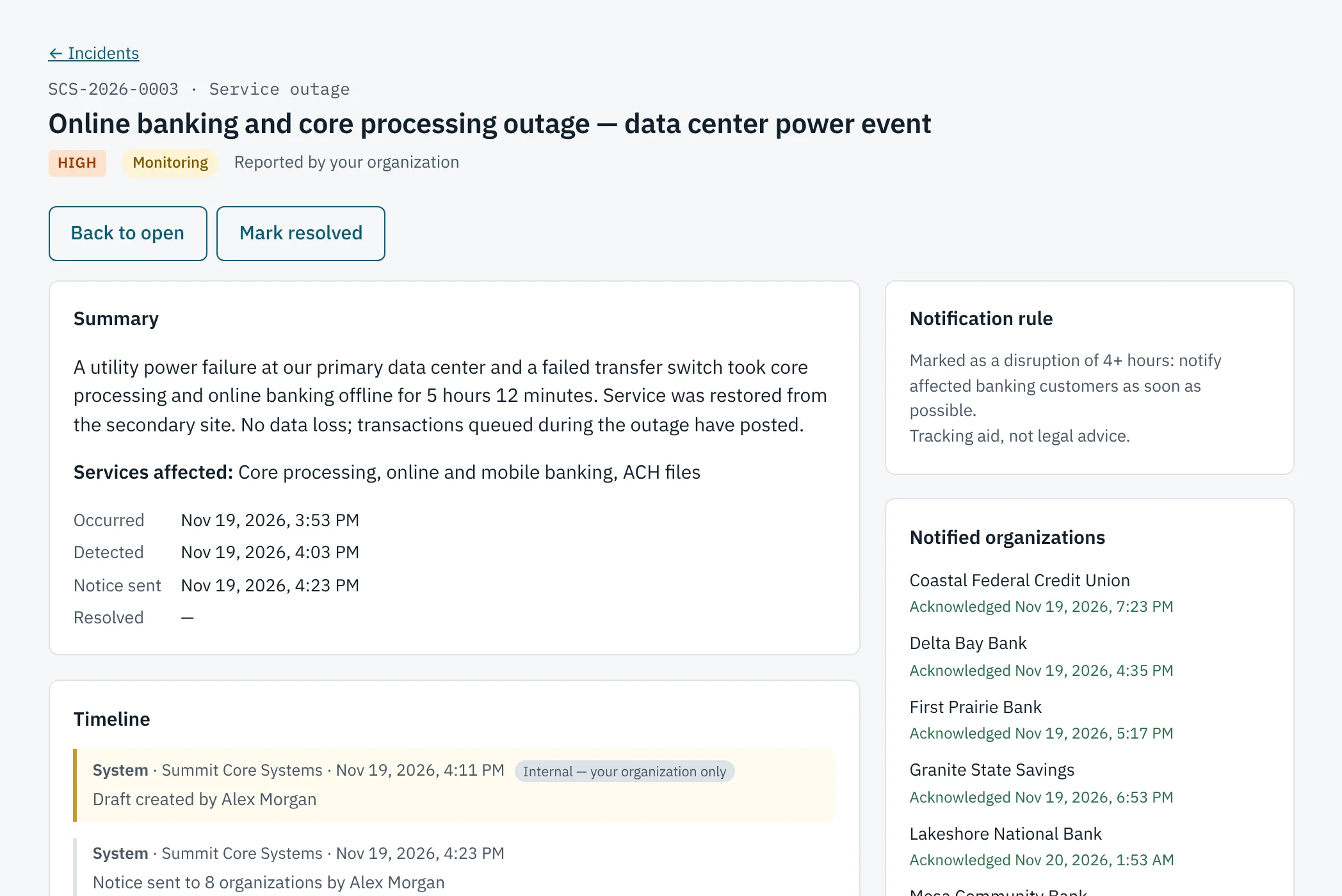
Know within minutes when a vendor has an incident

Your service provider posts one notice and every affected client receives it at once, with no phone trees or email chains.

  • Per-client acknowledgment. The provider sees who has confirmed receipt and who still needs a call.
  • One shared timeline. Updates, documents and status changes in one place; your internal notes stay internal.
  • Regulator clocks. Deadlines tracked from the time you determine an incident is reportable.
Incident record for a multi-client outage with acknowledgment status for eight banks

Your vendors, and their vendors

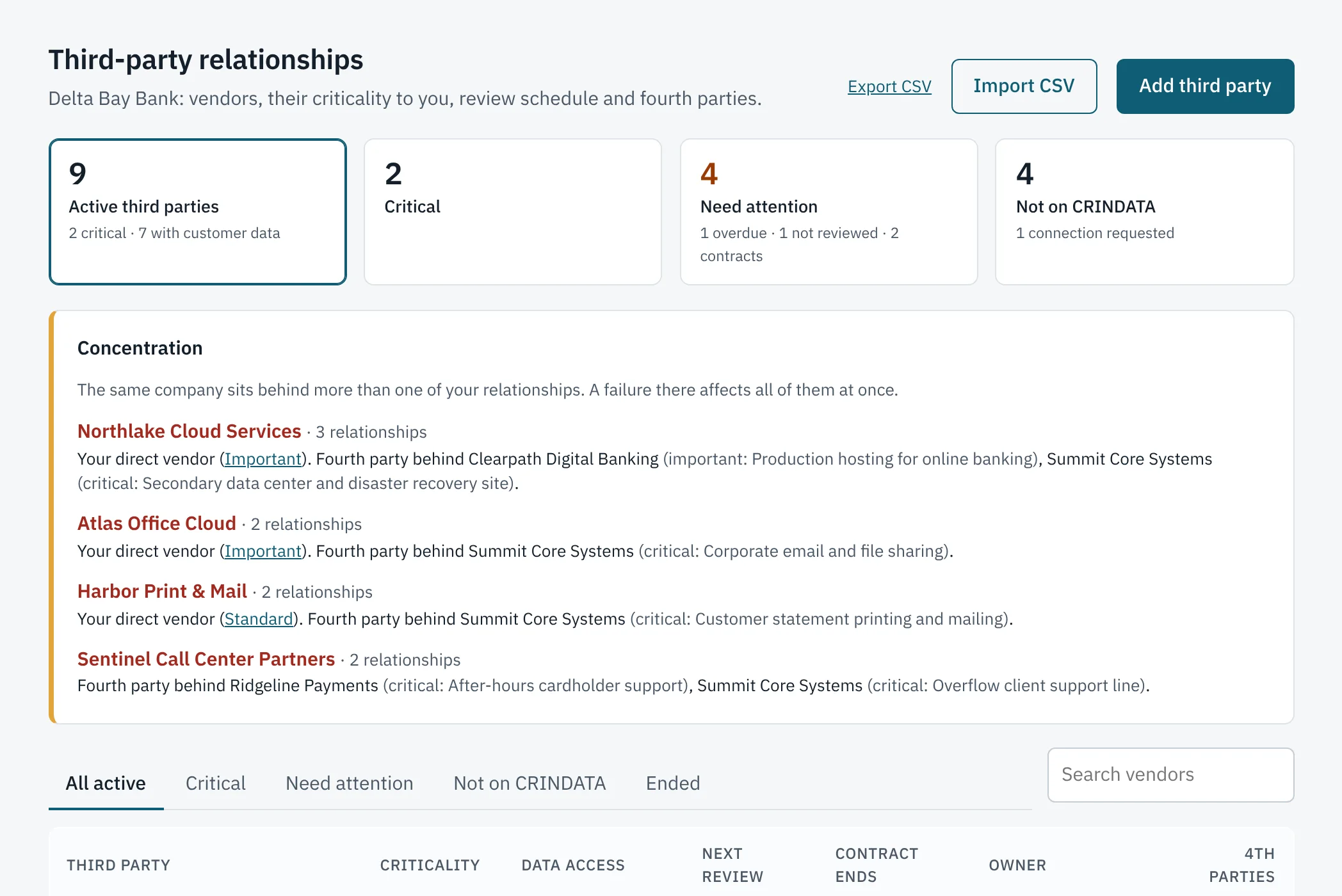
A third-party register organized the way the 2023 interagency guidance asks you to think: by criticality, data access and lifecycle.

  • Criticality with a reason. A short checklist based on the guidance’s critical-activity factors.
  • Review schedule. Overdue reviews and expiring contracts surface automatically.
  • Fourth parties and concentration. Vendors list their own subcontractors, and CRINDATA flags when one company sits behind several of your relationships.
Third-party register with concentration flags and review status

Evidence an examiner can rely on

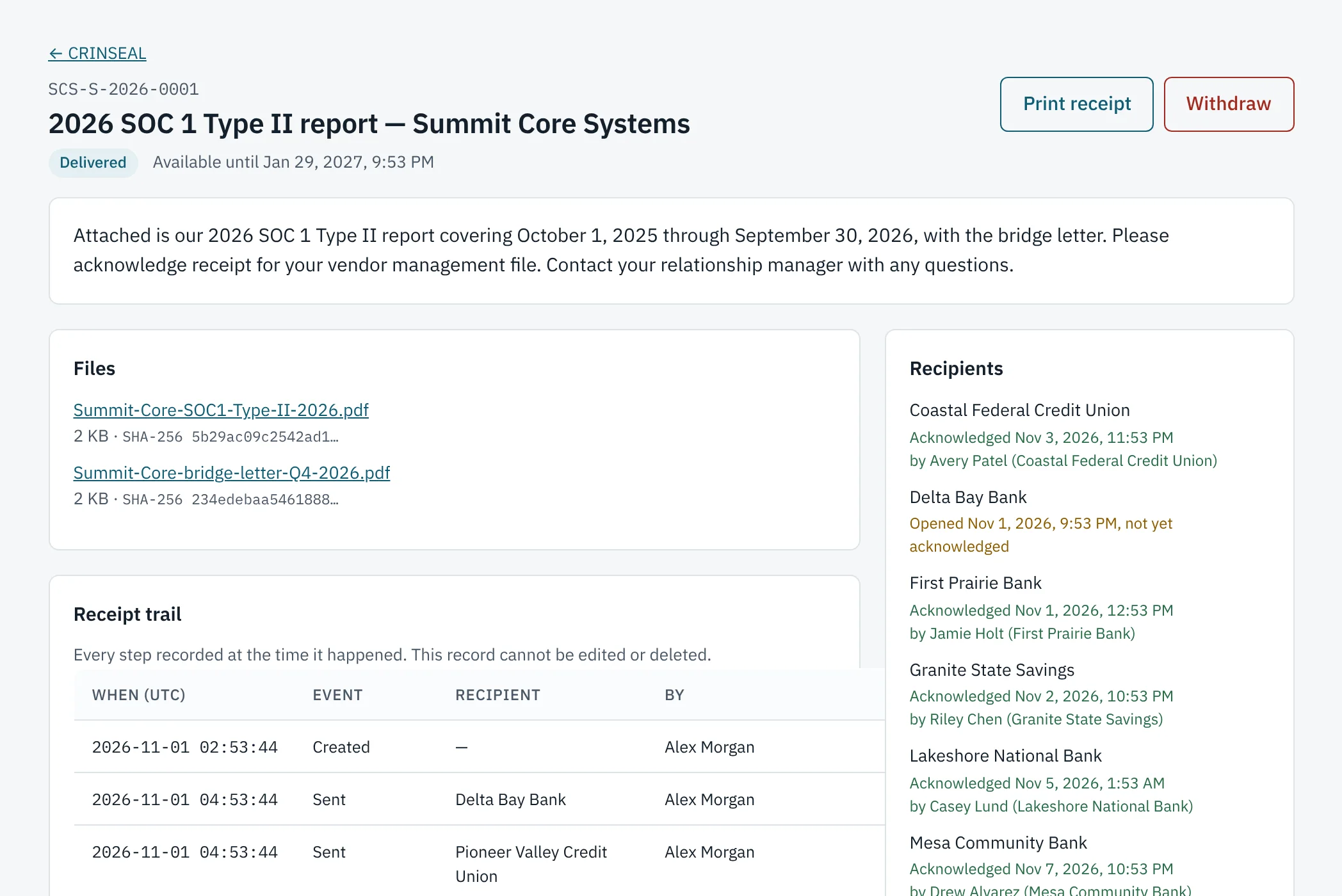
Every notice, acknowledgment, document and download is recorded at the time it happens, and the records cannot be edited or deleted.

  • CRINSEAL secure delivery. Send SOC reports, questionnaires and contracts with a receipt trail and file fingerprints.
  • Document library. Vendors share standing documents once; you see when each was viewed and downloaded.
  • Exports and printable receipts for exam files and board reporting.
CRINSEAL delivery receipt trail with timestamps, recipients and file fingerprints
Who is behind CRINDATA

Built by people who have spent careers on financial regulation

The sooner an institution knows, the sooner it can protect its customers. Most of the risk sits in the hours lost before anyone is told.

CRINDATA was founded to close that gap between financial institutions, their critical service providers and the regulators who oversee both.

James H. Freis, Jr.

Co-founder and Chairman

Longest-serving Director of the U.S. Treasury’s Financial Crimes Enforcement Network (FinCEN), 2007–2012. Previously at the Federal Reserve Bank of New York and the Bank for International Settlements; later responsible for compliance and regulatory relations at Deutsche Börse Group.

Mark Stetler

Co-founder

Attorney and Certified Anti-Money Laundering Specialist (CAMS) focused on BSA/AML compliance, financial services law and fintech; founder of RegSmart.

Two sides of the same relationship

Built for both ends of the notice

Banks and credit unions

  • Receive incident notices from critical vendors in minutes
  • Track the regulator notice deadline that applies to you
  • Maintain a third-party register with fourth parties and concentration flags
  • Collect SOC reports and due-diligence responses with a receipt trail
For financial institutions

Service providers

  • Notify every affected client at once, and see who has acknowledged
  • Meet the 4-hour notice duty with a timestamped record
  • Share SOC reports and policies once with every client
  • Answer due-diligence requests through one secure channel
For service providers
Security

Designed for information banks cannot afford to lose

Two-factor sign-in for every user

No exceptions, including administrators. Sessions end after 30 minutes of inactivity.

Each organization sees only its own data

Records are shared only between organizations connected to each other, and only what each needs to see.

Records that cannot be altered

Audit logs, receipt trails and messages cannot be edited or deleted, even by CRINDATA.

Encrypted files, logged downloads

Documents are encrypted at rest and fingerprinted on upload. Every download is recorded.

Alerts without the secrets

Email alerts say only that something is waiting. Details stay behind sign-in.

Your assessments stay yours

A bank’s criticality ratings and notes are never visible to the vendor.

See CRINDATA with your own scenarios

A 30-minute walkthrough of incident notice, the third-party register and examiner-ready records, from the bank side and the vendor side.

Request a demo